I’m an applied statistician who approaches problems from the perspective of functional and longitudinal data: curves, trajectories, distributions, and repeated measurements over time. Below are the main areas where that perspective has taken me.
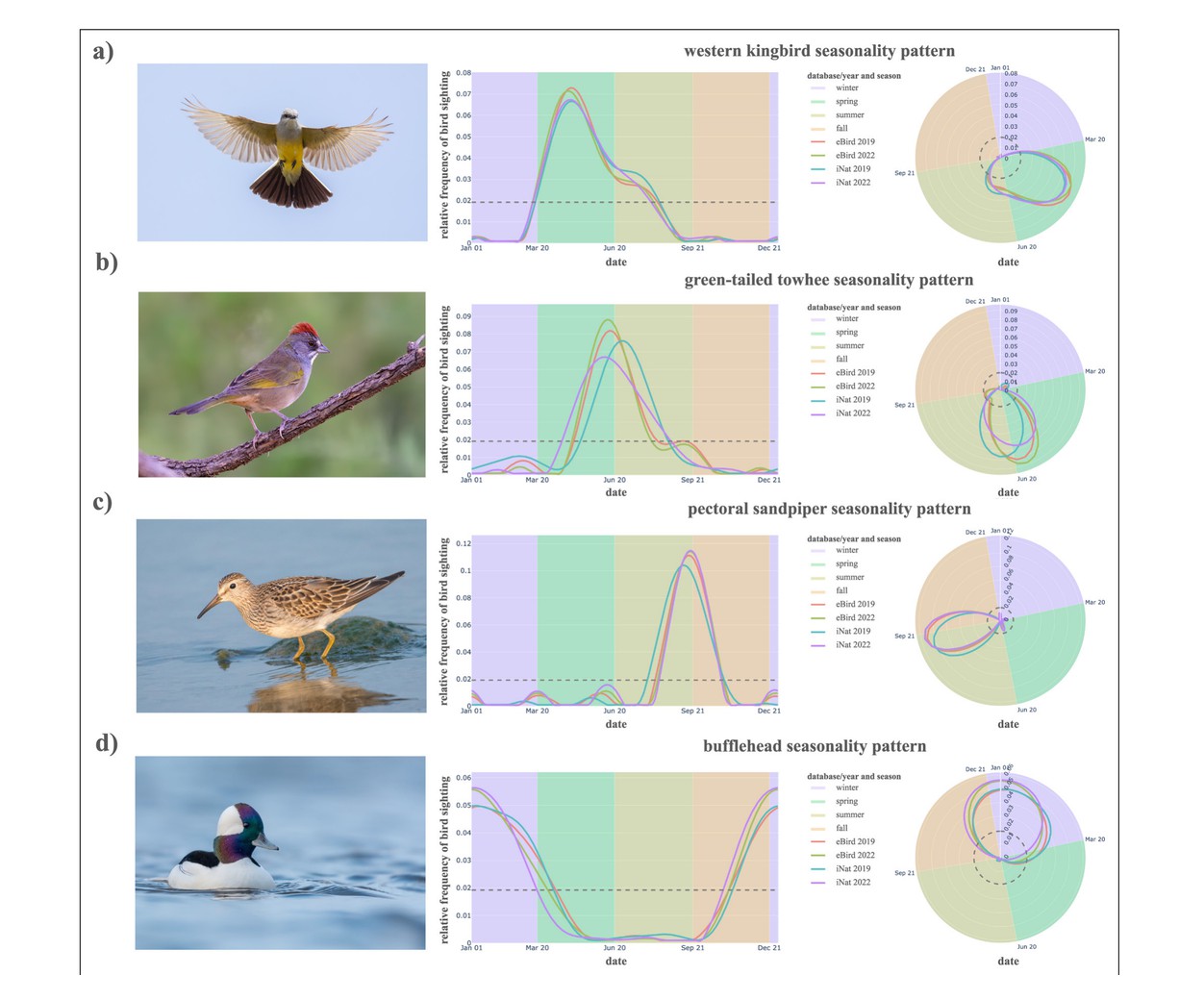 Seasonality of four bird species reconstructed separately from eBird and iNaturalist records. The two platforms largely agree on the timing of each species. From Carroll et al., Citizen Science: Theory and Practice (2025).
Conservation, citizen science, and biology
Much of my applied work has been in conservation and ecology, building automated tools for environmental monitoring and evaluating the data these fields rely on. With ecologists at UC Davis, I've validated participatory science data by treating each species' seasonality as a distribution over the year and comparing eBird and iNaturalist with circular optimal transport. More recently, I've been modeling bird migration routes as trajectories on the globe, using GPS tracks of black storks crossing from Europe to Africa. Work with The Nature Conservancy has produced satellite-based monitoring workflows for field flooding, an automated pipeline to count sea urchins for kelp forest restoration monitoring, and large language models for accelerating groundwater sustainability plan reviews. Alongside these, I have maintained the NorCal Bird Dashboard, an interactive tool for exploring bird observation data across Northern California. Collaborations in biology have included studying neonatal survival in non-domestic Caprinae with veterinarians at the San Diego Zoo and the comparative biology of a groundwater isopod. Separately, I have worked with the researchers behind the Himalayan Database on what predicts success and survival for Mount Everest mountaineers.
Selected work eBird vs. iNaturalist Seasonality (Citizen Science: Theory and Practice, 2025) · LLMs for Conservation Efficiency (Environmental Challenges, 2026) · Embryology and Transcriptomics of a Groundwater Isopod (Evolution & Development, 2025) · Mountaineers on Mount Everest (PLoS One, 2020) · Automated Sea Urchin Counting for Kelp Forest Restoration (The Nature Conservancy, 2026) · [Other Publications]
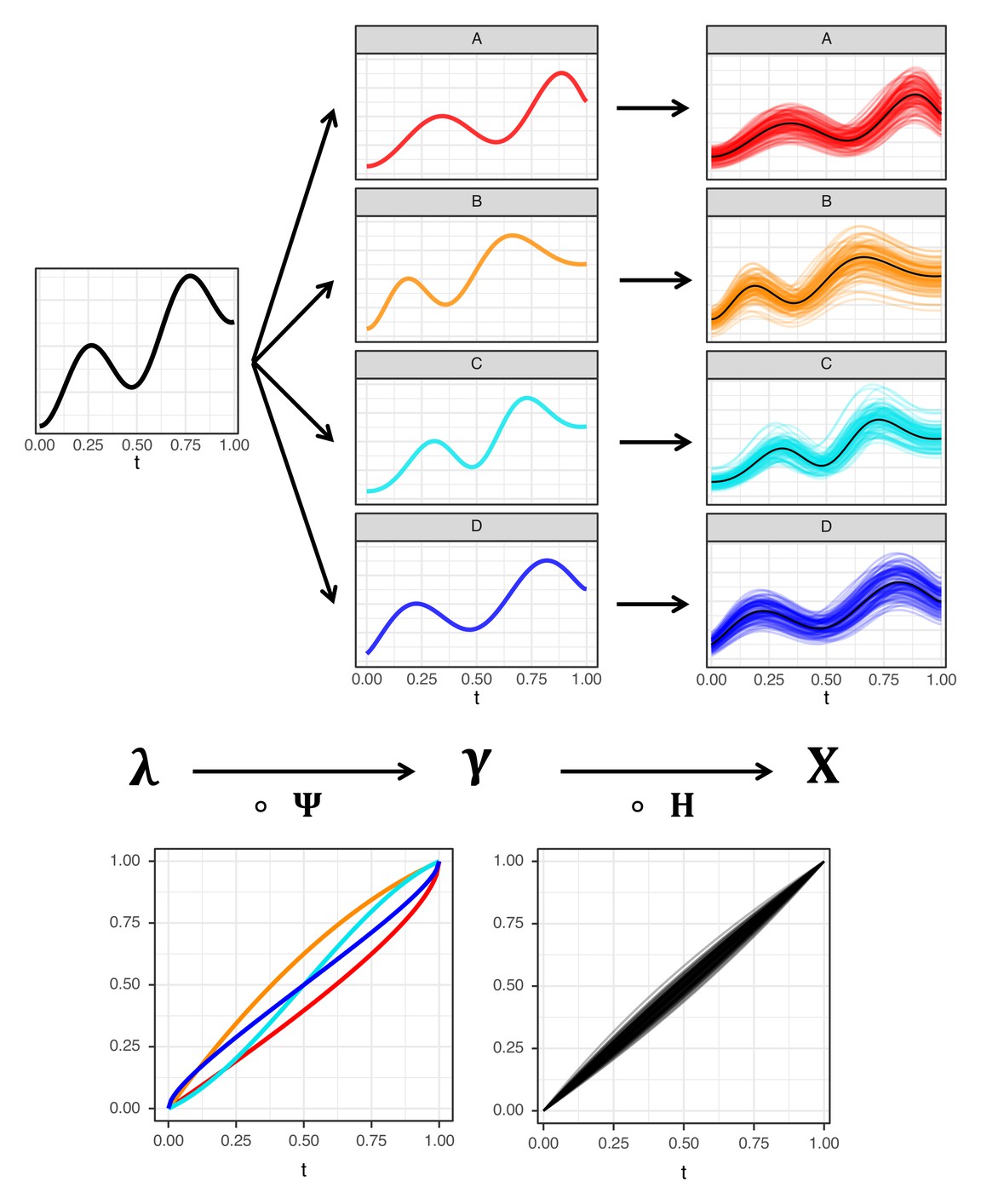 The latent deformation model assembles multivariate curves from a shared latent process, warping each component onto its own internal clock before the curves are observed. From Carroll and Müller, Biometrics (2023).
Biostatistics and functional data analysis
My methodological work has centered on functional and longitudinal data, particularly when the data involve multiple components or are subject to time warping. I have developed latent deformation models and cross-component registration methods for multivariate functional data, motivated by the study of human growth curves. These methods separate systematic phase variation, such as differences in the timing of growth spurts across individuals and across body measurements, from differences in amplitude. Beyond growth curves, I have applied the same tools to COVID-19, characterizing how case trajectories evolved across countries and forecasting case growth rates in the United States.
Selected work Latent Deformation Models (Biometrics, 2023) · Cross-component Registration (Biometrics, 2021) · Time Dynamics of COVID-19 (Scientific Reports, 2020) · Learning Delay Dynamics for COVID-19 Growth (J. Math. Anal. Appl., 2022) · fdapace R package · [Other Publications]
Statistical modeling of healthcare data
On the biomedical side, my collaborations have spanned vision, hearing, cancer, and mental health. ABRA, an open-source deep learning toolbox that automates the analysis of auditory brainstem response waveforms recorded across sound levels, has come out of a collaboration with auditory researchers in the Manor Lab at UC San Diego. At UCSF, I have studied kinase signaling in cancer with Hui Lin and Jean-Philippe Coppé, using graph neural networks and protein language model embeddings to identify the kinases that drive resistance to treatment. A separate project with the Capra Lab has applied protein language models, treating protein sequences as text to predict how mutations affect protein function. For the Ketamine Research Foundation, I have traced longitudinal change in depression and anxiety among adolescents and young adults receiving ketamine-assisted psychotherapy. Ophthalmologists at Stanford Medicine and I have used functional principal component analysis of visual field trajectories, together with electronic health records, to predict progressive vision loss in glaucoma patients.
Selected work ABRA Deep Learning Toolbox (Scientific Reports, 2026) · Ketamine-Assisted Psychotherapy in Youth (Frontiers in Psychiatry, 2026) · FPCA for Glaucoma Progression (Frontiers in Ophthalmology, 2025) · Knowledge-Based DVH Prediction (J. Appl. Clin. Med. Phys., 2021) · [Other Publications]
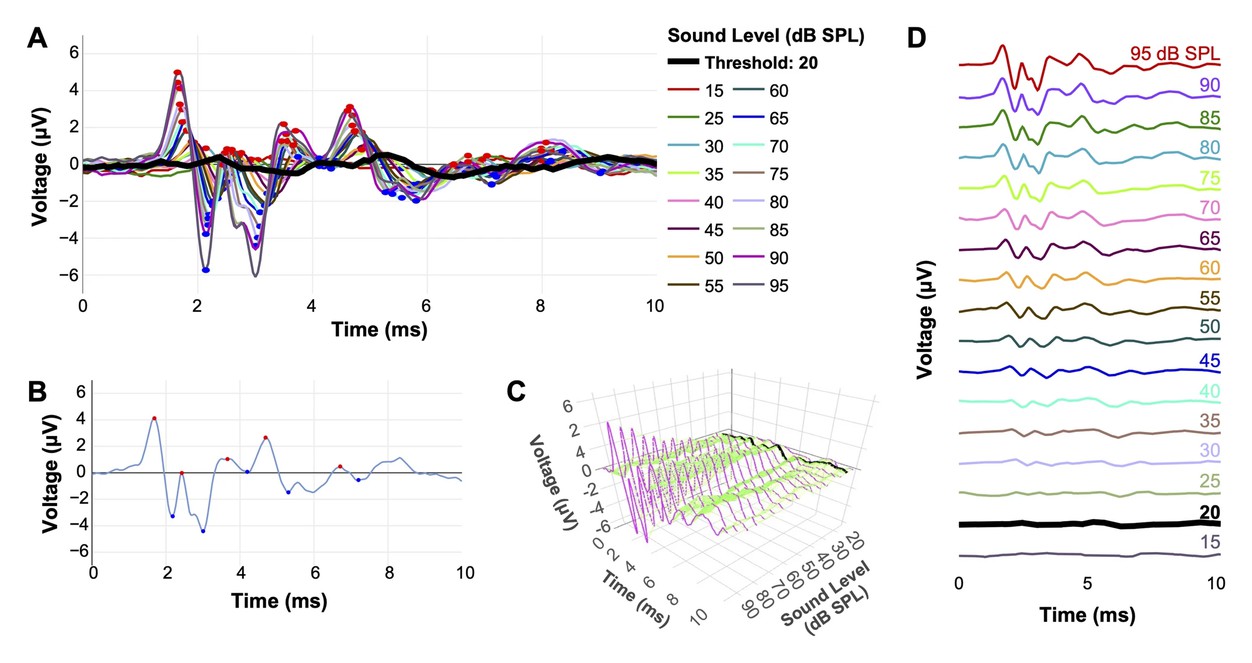 ABR waveforms analyzed across sound levels, with automated peak detection and threshold estimation. The hearing threshold is the lowest level at which a response is still detectable. From Erra et al., Scientific Reports (2026).
A full list of my publications can be found on my Google Scholar profile.